Free your GPU code
from CUDA lock-in.
ROCm Migration Copilot is an AI agent that ports CUDA codebases to AMD HIP/ROCm automatically — analyzing, translating, building, testing, and tuning GPU code on real MI300X hardware. One command in; a verified, documented HIP codebase out.
GPU code is trapped behind CUDA.
Millions of lines of production GPU code — from HPC simulations to AI inference servers — compile against one vendor's proprietary stack. Moving them to AMD's open ROCm ecosystem means weeks of manual rewriting by engineers who know both platforms. Almost nobody does. Syntax-only converters can't reason about kernels, memory models, or build systems — and nothing verifies the result on real hardware.
A five-stage agentic pipeline.
Analyze
AST parsing builds a kernel inventory and dependency graph; flags the long tail that hipify-perl misses.
Port
LLM agent translates CUDA APIs, kernels, and memory management to HIP with repo-wide context.
Build & Test
Automated compile and test loop on real AMD GPUs; every failure feeds back to the agent.
Tune
Performance advisor driven by Omniperf and Omnitrace profiles of the migrated code.
Report
Every change logged with a confidence score and a human-review checklist.
The build–test–fix loop runs autonomously until the port compiles and passes tests.
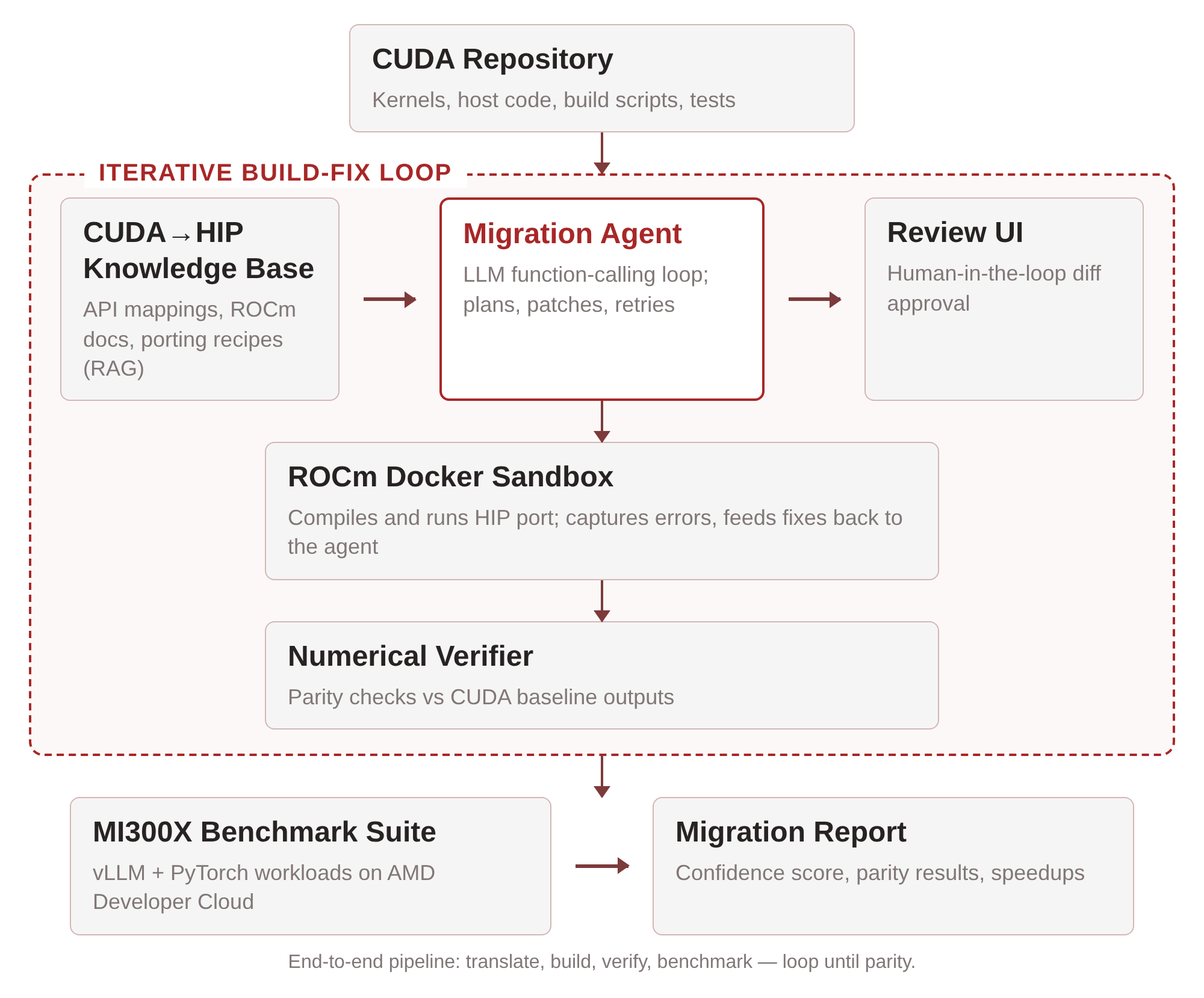
Under the hood.
Agent core
LLM with tool calling and RAG over official ROCm documentation.
AST precision
LibClang and Tree-sitter parse CUDA for surgical, structure-aware edits.
Self-healing loop
Compiler and test output drive the next fix — no human in the loop.
Orchestration
Python + LangGraph, running on ROCm-enabled MI300X cloud instances.
AMD, end to end.
ROCm
The open GPU software stack. Every layer inspectable, every commit public.
HIP
Portable runtime and kernel language — CUDA's structure, AMD's openness.
AMD Developer Cloud
MI300X instances through the challenge's $100 developer credits. No hardware required.
Omniperf + Omnitrace
First-class profiling feeds the tuning stage with real kernel-level data.
Runtime, cloud, profilers, docs — every layer of this project is AMD technology. That is the point.
September → December 2026.
Core pipeline
Analysis + HIP porting stages live; public repo open with weekly builds.
Hardware-in-the-loop
Build–test–tune loop running on MI300X; first end-to-end port demo.
Hardening
Bigger real-world repos, benchmark suite, migration report 2.0.
1.0 release
Docs, public video demo, launch post, final challenge submission.
Playing the scoreboard on purpose.
The AI Academy Challenge awards XP per category — this project is shaped to hit the highest-weight ones head-on.
Individual scoring — one builder, full accountability, zero coordination tax.
Give every CUDA codebase an escape hatch.
ROCm Migration Copilot — open source from day one, verified on MI300X. Built by Team ROCm Rangers for the lablab × AMD AI Academy Challenge.